Showing posts with label authors. Show all posts

Sunday, May 5, 2019

The Loss of Two Different Influences

Many of the people I interact with on social media have expressed grief and shock over the loss of two individuals within the world of Christian writing in the last few days. In the midst of the grief, people have recounted ways in which these two giants of the Christian faith have shaped and influenced the journey they have been on to follow Jesus. Warren Wiersbe and Rachel Held Evans in many ways could not be more different. I don't know that the two of them every interacted or discussed theology. I'm not sure that either would have known the other. The followers of each would hardly intersect with one another. Wiersbe, once the pastor of Moody Bible Church and a pastor to pastors is best known for his BE commentary series. Rachel Held Evans, was a blogger and author whose social media influence caused her to reach countless numbers of people. Wiersbe was older, having lived a full life. Rachel Held Evans was younger, 37 to be exact. She leaves behind two small children.

I have benefited by the writings of both of these individuals throughout my own spiritual journey and throughout my ministry. Rachel Held Evans would have classified herself as an ex-evangelical, and Warren Wiersbe would have considered himself a staunch evangelical, they both have much to offer the thoughtful believer in Christ. Christianity has lost two needed voices this weekend, my prayer is that God would continue to raise up men and women like them who speak the truth of the gospel in love for the generations still to come.

Wiersbe taught me the importance of engaging the biblical text for oneself. He taught me the necessity of rooting our sermons and Bible studies in the written word of God if we are to properly live our lives for the living word of God, Jesus. Rachel Held Evans helped me see that even when we are burned by the church (if it hasn't happened yet, it will), God's grace is bigger than our hurt or the personalities that perpetrated that hurt. She pushed me to see that scripture tells a grand story in which all our stories find meaning and purpose. These are two voices that have impacted American Christianity in untold ways. These are two voices that I pray God replaces soon.

I could be wrong in making this next statement, but it wouldn't be the first time. The tribe of evangelical Christianity that I identify with could use more people like Rachel Held Evans and Warren Wiersbe. I'll go one step further and say that if the umbrella of evangelicalism isn't large enough to listen to these two prophetic yet different voices then I am not sure how long our tribe will survive. Any author or preacher worth a dime should help us make sense of our faith, while pushing us to explore the nuances of our faith with questions. We would do well to remember that though God has revealed Himself perfectly in His word, the Bible, and through His son, Jesus, we are not perfect people (therefore we will mess things up, get things wrong, and twist things to suit our own agendas and biases rather than God's).

I did not agree with everything that Rachel Held Evans believed or supported. I'm sure the same could be said about Warren Wiersbe. I do know that both of them loved Jesus fought for the faith one and for all delivered to the saints. May we find ourselves willing to do the same.

Join me in praying for their families during this season of loss. May God provide comfort and peace.


Tuesday, July 3, 2018

Southern Writing

My wife and children gave me Harper Lee's Go Set A Watchman for some occasion in the last few years since it was released. To be honest I can't remember if it was Father's Day, Christmas, or birthday. Either way they know my love language is books, so they purchased it for me. Earlier this year I reread Lee's classic, To Kill A Mockingbird in anticipation of reading Go Set A Watchman. I recall others commenting that they didn't like Atticus Finch in the second book or something else about the book that disillusioned them surrounding the mystique of Harper Lee or the legendary book she was known for nearly all her life. Though I enjoyed To Kill A Mockingbird more, I really liked Go Set A Watchman

I liked it for the same reason I like most southern writing, particularly southern fiction. In the pages of Flannery O' Connor, Harper Lee, Walker Percy, Will Campbell, Ferrol Sams,  Pat Conroy, and others one is confronted with the hypocrisy of the south in all its glory. One is forced to wrestle not just ideologically but personally with issues of rich and poor, black and white, educated and uneducated. One reads the characters in these pieces of literature and finds glimpses of self shining through. Questions of ideals, racism, sexism, and even theological tensions. Many of the famed southern authors have faith or at least religion somewhere in his or her identity which manifests itself in the ink of the page. I read these authors because I find traces of myself in each book. Things about me that I like, things I don't like. Things I have changed, things I want to change. Ultimately each author and each of the books by them I have read push me to examine who I am as a person, a Christian, a husband, a father, and a friend...because of this I will keep reading.

Saturday, June 23, 2018

Food for Thought

I measure the value of a book by how long I keep chewing on thoughts and ideas from the book long after I have reshelved it. Here we are halfway through 2018 and I keep being drawn back to things I read in Eugene Peterson's book, As Kingfishers Catch Fire. You may recall seeing headlines with Peterson after his interview with Jonathan Merritt a year ago in which Peterson first came out seeming to support same-sex marriage. Peterson later retracted his statements and affirmed a traditional understanding of marriage between one man and one woman.

I was eager to read As Kingfishers Catch Fire because I had benefited so much from many of Peterson's other books. I also was at a crossroads in ministry in which I was evaluating where and what God was calling me to do for the next phase of my life. The book is a simple collection of sermons spanning the 29 years Peterson pastor Christ Our King Presbyterian Church, which he planted. The collection is grouped around various biblical characters as Peterson saw himself preaching in the company of those individuals and the larger company of the saints of God. Now to be honest, reading sermons is usually less moving that hearing the sermons. This maxim holds true in this collection as well, though there are some stellar moments in the sermonic journal.

Perhaps for me it was my identity with Peterson's own struggle to find his way of being a pastor in the midst of the expectations that his denomination and culture put on him to be a pastor. In other words, the denomination expected him to grow in attendance by a certain percentage, grow in giving, educational endeavors, and various other "measurables". From the Preface, "But as time went on, I found myself increasingly at odds with my advisors on matters of means, the methods proposed for ensuring the numerical and financial viability of the congregation but without even a footnote regarding the nurturing of souls." He goes on to write that he had grown weary with laying out strategies and "casting visions". Instead, he wanted to nurture the souls of his congregation and walk alongside people as they figured out what it means to follow Jesus throughout life. As I read the Scriptures and grow in my own faith I have come to the conclusion that making disciples is not the same as casting a vision or developing a strategy to make disciples...it is MAKING disciples. It is building relationships with people, getting to know them, and patiently but boldly sharing with them the good news that Jesus Christ lived a perfect life, died on the cross, and rose again from the dead thereby bringing reconciliation between us and God. This indeed is the gospel, this indeed is good news!!

Peterson drawing on inspiration from Gerard Manley Hopkins traces the way that Christ plays in ten thousand faces and places. He writes, "The Christian life is the lifelong practice of attending to the details of congruence--congruence between ends and means, congruence between what we do and the way we do it, congruence between what is written in Scripture and our living out what is written, congruence between a ship and its prow, congruence between preaching and living, congruence between the sermon and what is lived in both preacher and congregation, the congruence of the Word made flesh in Jesus with what is lived in our flesh."

Like so much of Peterson's library, there aren't always small nuggets of truth to tease out and quote on social media. Instead Peterson ushers you into the throne room of God and allows you to reflect on all that is and all that could be in a life of faith. Peterson nurtures the souls of his congregation while also nurturing the souls of his larger adopted congregation of his readers. He doesn't disappoint, nor does he wow the reader. Instead he simply offers his thoughts on what it means to follow Jesus and invites us to follow along with him. One year later I am still finding strength and encouragement from this book.

Monday, October 9, 2017

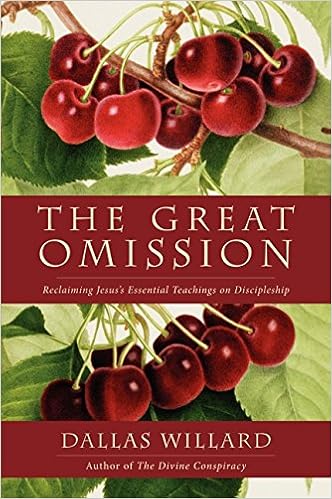
The Great Omission


The late Dallas Willard probably influenced more people in the art of discipleship and spiritual formation than any other writer in the last 50 years. Willard drew on the best of church history and Christian spirituality to help modern readers understand the essential teachings of Jesus. His books are a worthy investment even though at times they can be challenging to digest.

In The Great Omission, one finds a collection of articles, lectures, and other pieces clustered around the idea of discipleship. At times the book is repetitive given the nature of the compilation, but it is a great introduction to the thoughts of Willard. Willard contends that the great omission of the church is that we have focused on making converts (to a particular stream of Christianity) and baptized them into church membership without ever "enrolling people as Christ's students." The goal is formation of the inner character to be developed that operates out of the mind of Christ.

Tuesday, January 8, 2013

Telling the Story

Richard B. Hays in his pivotal book on Christian Ethics states that the New Testament is not a unified dogmatic system of belief, but rather a collection of documents that tell and retell a common story. He summarizes the story this way...
The God of Israel, the creator of the world, has acted (astoundingly) to rescue a lost and broken world through the death and resurrection of Jesus; the full scope of that rescue is not yet apparent, but God has created a community of witnesses to this good news, the church. While awaiting the grand conclusion of the story, the church, empowered by the Holy Spirit, is called to reenact the loving obedience of Jesus Christ and thus to serve as a sign of God's redemptive purposes for the world.

 I often ask myself how am I doing at obeying Christ and striving to be a part of God's redemptive purposes for the world, which he loved so much he gave up his only Son!


Sunday, December 30, 2012

Confusing Ministry and Calling

Margaret Feinberg recalls a conversation she had with a friend who had been dismissed from his ministry at a large church because of a moral lapse. The guy makes the statement that one's calling never changes, but our ministry can change every few minutes, at least several times in the course of our lives. She quotes him as saying, "The problem is that all too often we sacrifice our calling for the sake of the ministry. The ministry becomes so important, so central, that we lose the most important thing."

A great reminder for all those in vocational ministry. Our specific task of ministry may change repeatedly, for example in the last year I have transitioned from doing youth ministry to doing college ministry. Yet my calling has remained, seeing people's lives changed by the gospel. Of course most of us need to be reminded this important truth several times a week because we get so wrapped up in our ministry that we begin to place our self worth and value only in what we accomplish through ministry.

Excerpted from The Sacred Echo

Power of Words

Margaret Feinberg writes,
Why use sixty-six books and thousands of years of history to say three simple words? Because "I love you" is not just a piece of information or one-time revelation but an invitation to transformation.

Amazing to think of the trouble that God has gone through and still goes through to express his deep, unconditional love for us. He stopped at nothing, even sacrificing his only son because of his love affair with His people!

She goes on to say the following:
With mere words, God created. except for the moment when Jesus spoke, "It is finished," never has so much been accomplished in so few words.

I have always been mesmerized by the power of words, especially when contemplating the creation accounts in Genesis 1 and 2. The sheer power and authority evident in God's ability to speak something out of nothing, creation ex nihlio. This is the same God whom we bow down and worship as the loving Father who redeems us through his son, forsaken on a wooden cross. Two very simple acts with profound influence on the course of human history.


Monday, December 17, 2012

The Sacred Echo by Margaret Feinberg

I recently finished The Sacred Echo by Margaret Feinberg. She has quickly become one of my favorite contemporary writers. Her insight into issues of faith are refreshing without pushing the boundaries of orthodoxy. I will spend a few blog posts responding to some of her thoughts over the next few days. Here is one at the end that really resonated with me.

The naked truth about "getting saved" is that becoming a follower of Jesus will not make you richer, skinnier, or more prosperous. It will cost you everything--more than you can imagine--as you pour your life into causes that no one else seems to care about. But the rewards, well, I'm gambling with everything I've got that they're worth it. Like Lucy, it's worth believing and bringing everyone I possibly can along for the adventure (187).


Thursday, October 18, 2012

Where is God when life hurts?

Philip Yancey is one of my favorite writers. He tackles every situation and scenario with poise, authenticity and a Biblical worldview. I am using his Grace Notes as part of my devotional reading this year. I have read just about every book he has in print, but it is great to reread some of these statements again and be encouraged by the hope of Christ! Here is what today's selection said,
Where is God when it hurts? God is in us--not in the things that hurt--helping to transform bad into good. We can safely say that God can bring good out of evil; we cannot say that God brings about the evil in hopes of producing good.
 Where Is God When It Hurts? (108-109)

Wednesday, April 25, 2012

Nouwen on Leadership

"the Christian leader of the future is called to be completely irrelevant and to stand in this world with nothing to offer but his or her own vulnerable self." "Christian leaders cannot simply be persons who have well-informed opinions about the burning issues of our time.their leadership must be rooted in the permanent, intimate relationship with the incarnate Word, Jesus, and they need to find there the source for their words, advice, and guidance." Preparing for a college ministry retreat later in May and came across these great insights from Henri Nouwen. Isn't the temptation to be relevant one of the greatest challenges facing the church in 2012.

Tuesday, March 27, 2012

Loving Difficult People

Calvin Miller delivers a wonderful resource for ministers in his recent book, Letters to a Young Pastor. Miller draws on his 30 years of pastoral ministry and his perspective as a seminary professor to encourage, caution, and challenge a new generation of pastors. Essential reading for anyone in ministry!

Above all, never hate anyone. 
John said that to claim to love God and hate your brother is but a great deception that blinds you to what you really are, the certified lover of the church, all of the church, starting with the difficult people.  
Most people are difficult once in a while. In fact, nearly everybody is a problem to somebody, sometime, somewhere. You must decide whether to solve these people problems, cope with them, ignore them, or run them off. Pastor, I know that in ministry it gets hard to like everybody. Will Rogers did, I know, but then there's a general feeling that while Will never met a man he didn't like, he never really got out all that much. And I'm pretty sure he never pastored a church. 

I think you could insert served a church rather than pastored, because anyone who serves in a ministerial position faces this challenge weekly.

The Need for Christian Thinkers

John Stott in his commentary on Acts writes, 
There is an urgent need for more more Christian thinkers who will dedicate their minds to Christ, not only as lecturers, but also as authors, journalists, dramatists and broadcasters, as television script-writers, producers and personalities, and as artists and actors who use a variety of art forms in which to communicate the gospel. 
The Millennial generation is less influenced by talking heads who lecture about the incarnation of Jesus Christ than any other generation in history. They are more open to traces of the transcendent in pop culture. The church must find ways to communicate the gospel in new forms, even newer ones than Stott mentions, but include those he references if we will see future generations encounter the living Christ! We don't just need new generations of missionaries and preachers we need believers in all vocations to make Yahweh famous.

Monday, March 26, 2012

The Demands of Jesus

In comparing the demands of the contemporary, evangelical church to the demands of Jesus, Mark Galli finds the church sufficiently lacking. It seems that in the church we want to make it as easy as possible to follow Jesus, yet that doesn't square with the picture of Jesus in the gospels.

So it seems we want some theological and moral demands made on us, but just not too many. Give us a somewhat challenging faith and we do just fine.  
Then along comes Jesus, telling us to cut off a hand or foot or cut out an eye if it gets in the way of serving him. He instructs us to abandon wives, sisters, brothers, and friends and put our lives on the line. I don't know about  you, but I'd much rather tithe, pray daily, serve on a couple of church committees, lead a men's Bible study, serve on the church board, and attend weekly worship. As exhausting as it is to be a good churchman, it's infinitely easier than the demands Jesus would make on my life.  
The point is simply this: if we've given ourselves to a contemporary, high-demand expression of faith, we should recognize that it doesn't even approach the demands Jesus makes on us. Even monastics, old and new, know that their sacrifices are ridiculously meager. And when this reality hits us from time to time--as well it should, if we're at all honest with ourselves--the only reasonable reaction is fear and trembling. What else would a sane person do after realizing that Jesus wants nothing less than all of us--every molecule, every breath, every ounce of energy, every interest, every passion, every thought, every action, every love? It certainly scares the bejeebers out of me (134-136). 


Tuesday, November 29, 2011

Fosdick on Faith

Harry Emerson Fosdick, was a key figure in the religious life of America in the mid 1900s. He was a polarizing force in that he adamantly combated the fundamentalists that had risen up in response to the cresting tide of theological Liberalism, yet he later in life criticized many of the shortcomings of Liberalism and embraced a form of Neo-Orthodoxy.

I have always heard or read his name either in high regard or complete contempt. Having never read anything by him I chose a book that has been on my shelf for years to read entitled A Faith for Tough Times. Fosdick was definitely someone who marched to his own beat not giving a care as to what others may think. Still in the book I found some nuggets of wisdom and insight.

Here is one:
When on undertakes to find the permanent in this transitory world one naturally turns to huge things, powerful things, which ostentatiously loom large and dominate the scene. But the Christian faith lights on an obscure Galilean, whose family thought him demented, whose church thought him a heretic and excommunicated him, whose friends thought him a failure and disowned him, whose nation thought him a traitor and crucified him. (40-41)

Monday, September 26, 2011

Evil pt. 2

Most of the quotes in this post from N.T. Wright's book on evil center around what Wright argues is God's ultimate solution to evil, the crucified savior. Wright's own view of understanding the atonement, is the Christus Victor view, that has strong historical roots in such people as Martin Luther and into the modern era of biblical scholarship as Gustaf Aulen.

But when we ask the question, Why did Jesus die? with an eye to the deeper issue of why, in the purposes of God, Jesus might have had to die, we move from historical analysis of events and motivations to a theological account of what God decided to do about evil. That, ultimately, is what theories of "the atonement" are all about. p. 75

The Gospels tell the story of how the evil in the world--political, social, personal, moral, emotional--reached its height, and how God's long-term plan for Israel (and for himself!) finally came to its climax. They tell both of these stories in--and as--the story of how Jesus of Nazareth announced God's kingdom and went to his violent death.  p. 79

We realize with a start that he has been obedient to the Israel-vocation which he had himself announced in the bracing and so often misunderstood Sermon on the Mount. He had turned the other cheek. He had picked up the Roman cross and gone the second mile. He was set up on the hill, unable to be hidden. He was acting as Israel, the light of the world, on behalf of the Israel that had embraced the pagan darkness. p. 85-86

This (the last supper with his disciples) was Jesus' own chosen way of expressing and explaining to his followers, then and ever since, what his death was all about. It wasn't a theory, we note, but an action (a warning to all atonement theorists ever since, and perhaps and indication of why the church has never incorporated a specific defining clause about the atonement in its great creeds). Perhaps, after all, atonement is at its deepest level something that happens, so that to reduce it to a proposition to which one can give mental assent is a mistake at a deep level. p.91

This, the Evangelists are saying to us, is what "the kingdom of God" means: neither "going to heaven when you die" nor "a new way of ordering earthly political reality" but something which includes both but goes way beyond them. p.93

No, all theories of atonement adequate to the task must include both a backward look (seeing the guilt, sin and shame of all previous generations heaped up on the cross) and a forward dimension, the promise that what God accomplished on Calvary will be fully and finally implemented. p. 96

Friday, July 8, 2011

Kingdom Minded

"The only significance of life consists in helping to establish the kingdom of God."  Leo Tolstoy

Why do we look for significance, meaning and belonging in so many other places other than the Kingdom of God?

Friday, June 24, 2011

Tom Wright on the Bible Part 2

Here are a few more quotes from N.T. Wright's recent book on the Bible.

The trouble with all this is of course the lack of control. Once you can make scripture stand on its hind legs and dance a jig, it becomes a tame pet rather than a roaring lion. It is no longer "authoritative" in any strict sense; that is it may be cited as though in "proof" of some point or other, but it is not leading the way, energizing the church with the fresh breath of God himself. The question must always be asked, whether scripture is being used to serve an existing theology or vice versa. (p71)

To affirm "the authority of scripture" is precisely not to say, "we know what scripture means and don't need to raise any more questions." It is always a way of saying that the church in each generation must make fresh and rejuvenated efforts to understand scripture more fully and live by it more thoroughly, even if that means cutting across cherished traditions. (p.92)

It is with the Bible in its hand, its head, and its heart--not merely with the newspaper and the latest political fashion or scheme that the church can go to work in the world, confident that Jesus is Lord and Caesar is not. (p.116)

We dare not try to tame the Bible. It is our foundation charter; we are not at liberty to play fast and loose with it. (p.132)

Tuesday, May 10, 2011

The Heart of Prayer

I recently spent some time with one of my favorite authors, Fisher Humphreys. Humphreys writes in a clear, simple yet elegant manner. He always has the ability to take the most complex thing and present it in a way that people can readily understand. In The Heart of Prayer he traces how pray works in our lives as believers in Christ.

No one prays enough, or is good enough, that he deserves to be heard by God. God always listens because he is gracious, not because we deserve it (65). 

He must refrain from trying to manipulate or impress God, because what motivates God to listen and to respond is not any virtue or activity in the one who prays, but rather God's own infinite love (75).

Wednesday, April 6, 2011

A Mind Awake

I recently worked my way through an anthology of C.S. Lewis entitled, A Mind Awake. Lewis is the elder statesman of much of current evangelical thought on life, faith, and doctrine. Curiously, Lewis was not a theologian by training so he doesn't get everything right in my opinion, but he offers so much wisdom and depth and insight into a life that is lived in the light of the risen Savior.

Two excerpts I want to share with you on the matter of love...

You cannot love a fellow-creature fully until you love God.  The Great Divorce

Love anything, and your heart will certainly be wrung and possibly be broken. If you want to make sure of keeping it intact, you must give your heart to no one, not even to an animal. Wrap it carefully round with hobbies and little luxuries; avoid all entanglements; lock it up safe in the casket or coffin of your selfishness. But in that casket--safe, dark, motionless, airless--it will change. It will not be broken; it will become unbreakable, impenetrable, irredeemable. The alternative to tragedy, or at least to the risk of tragedy, is damnation. The only place outside Heaven where you can be perfectly safe from all the dangers and perturbations of love is Hell.
The Four Loves

Wednesday, March 30, 2011

Does Love Really Win?

The media tizzy that has swept across evangelicalism over the last several weeks regarding Rob Bell's book Love Wins has been intriguing to say the least. The subtitle reads, A Book About Heaven, Hell, and the Fate of Every Person Who Ever Lived raised more than a few eyebrows of mostly the low brow evangelical type. It's interesting that I haven't heard much commentary from folks in mainline denominations about the book and the controversial figure behind the book. HarperOne, the publisher of the book, released a video with Bell introducing the book by telling a story about how the eternal destiny of Ghandi, this alone has made people denounce Bell, his book, and his salvation. I followed a few of the comments in blogs, Twitter, and Facebook and had a few conversations with people about Bell and the book, but I was convinced that I wouldn't make a judgment call about the book until I read it for myself. Sadly, many of the people who cast Bell and Love Wins into outer darkness reacted to a provocative video without ever reading the book for themselves.

I received my copy about a week or so after it was released. I can honestly say that Bell is quite good at asking questions, challenging the status quo of faith in a typical post-modern fashion...he provides lots of questions and very few answers. I think it is important for many in the church to realize that the rising generations (millenials, etc.) are quite comfortable with all the questions that may or may not lead to hard, conclusive answers.

Bell is aware that what he shares in this book is controversial and on the fringes of Christian tradition (many would consider is conclusion to be outside the bounds of historic Christian orthodoxy while others would permit the freedom to hold to different views on the destiny of everyone who has ever lived within the broader umbrella of Christian faith in the Living God). Bell is what he calls an exclusive inclusivist, meaning he believes that Jesus is the way to salvation but that the "all-embracing, saving love of this particular Jesus the Christ will of course include all sorts of unexpected people from across the cultural spectrum." He calls it "exclusivity on the other side of inclusivity" (155).

While I disagree with Bell's conclusion, I think intrinsic to his argument is the truth that we are finite human beings who cannot begin to fathom the depths of the mind and heart of God. Yes, we have the Bible, God's written revelation of his relationship with his people and how he has chosen to reveal himself to the world, most particularly in the person and work of Jesus Christ. That being said, I don't believe that I serve a God who is limited to act in only the ways he has acted in the pages of the Bible, if I did, I believe my view of God would be diminished because that would be a small God to serve. If God spoke creation into existence, made redemption possible through the cross of Jesus Christ, and is still at work in people's lives then who am I to pretend to know the mind of God and his complete plan of redemption. Let me reiterate, I am not a universalist or and inclusivist like I believe Bell is, nor do I think scripture can truly defend those positions, but if God wanted to save people through Jesus in a way that I don't fully comprehend based on the knowledge of God that I have and the revelation of scripture then he isn't a very big God. All that being said, I don't think that will be the case (that God will save people through Jesus even after this earthly life is over) but I am willing to let God have the final verdict on that topic.

A few things sadden me about Bell and his book...1. The lack of grace given to a fellow brother or sister in Christ. I am not saying that heresy should go unchecked within the body of Christ, but shouldn't the effort always be made to restore someone who holds erroneous beliefs about the faith. Ultimately, no one else is the judge of Bell's own heart and relationship with God except God. I am truly grieved that Christians who have experienced God's grace we are often the least likely people to be dispensers of the grace to other people (inside and outside of the church). 2. I regret that someone as influential as Bell would come to the conclusions he has reached, although I think he ultimately throws his hands up and says that he's not 100% sure of people's eternal destiny, but this (his questions and thoughts in Love Wins) are his attempt at trying to make sense of it all. Questions are good things, especially about faith...I am reminded of a quote I found from C.S. Lewis not long ago that says, "I know now, Lord, why you utter no answer. You are yourself the answer. Before your face questions die away." His influence as a pastor and leader are somewhat troubling when he reaches these conclusions but I would also point out that for me, him getting this wrong doesn't negate his own life change and being right in other areas of his own theology. I think ultimately Love Wins like other books by Bell is an attempt to work out his own theology in the context of writing, which can be very dangerous. I strongly encourage anyone to read the book before joining the masses in condemning Bell, you may reach the same conclusion, but at least you will have made that decision for yourself.


Some other interesting Blog posts about Rob Bell and Love Wins:
http://www.brookhillscollege.org/?p=1284

http://www.gregboyd.org/blog/rob-bell-is-not-a-universalist-and-i-actually-read-love-wins/

http://thegospelcoalition.org/blogs/justintaylor/2011/03/13/rob-bells-love-wins-a-response/

http://thegospelcoalition.org/blogs/kevindeyoung/2011/03/14/rob-bell-love-wins-review/

http://www.redletterchristians.org/love-wins-rob-bell-and-the-new-calvinists/

http://www.patheos.com/community/jesuscreed/2011/03/23/rob-bell-and-c-s-lewis-by-jeff-cook/

 http://www.patheos.com/community/jesuscreed/2011/03/02/waiting-for-rob-bell/

http://fromagetoage.posterous.com/10-rob-bell-articles-that-didnt-make-the-cut
This one might be my favorite!