Showing posts with label Books. Show all posts

Saturday, March 6, 2021

Prayer

I am reading a new book by Tish Harrison Warren entitled Prayer in the Night. She wrote this book after a season of loss she experienced with a move half-way across the country, the passing of her father, and two miscarriages. She recounts how she found great solace in praying. She took up the practice of praying compline, a traditional evening prayer practiced by many Christians, especially within the Anglican communion across the world. In the Prologue she writes, "Most often, we take up prayer not out of triumphant victory or unimpeachable trust but because prayer shapes us; it works back on us to change who we are and what we believe" (9). 

In my own experiences with prayer, I have witnessed how my prayer life is less shaped by me and more about the process of being shaped by the Holy Spirit as I surrender myself to the Lord's authority in my life. Prayer opens me to the possibility of what the Lord is teaching me, sharing with me, and shaping me to become. Prayer opens my heart to those around me experiencing loss or grief. Prayer makes me sensitive to the needs of people I encounter in the coffee shop, at the store, and in my own home. When I pray, my defenses are lowered and I see others the way I see myself, a fragile human in need of God's mercy, grace, and love to make it through each day. 

This week, I have found my prayers opening to me the mystery of our journey towards the cross. It's been a challenging week in our house as we all had to quarantine, but it's been a week in which the Lord opened to me the needs of others in ways that are too often overlooked. 

Friday, April 17, 2020

The Contemplative Pastor

I have long admired Eugene Peterson. The former pastor, professor, and translator of The Message has a way of speaking truth in the most subtle of ways. Peterson's primary vocation was as a pastor. His knowledge of pastoral ministry and his insight into the demands and joys of pastoral ministry is in many ways unmatched. Perhaps his experience and knowledge is so significant because he is able to use the precision of a surgeon's knife to trim the dead parts of the pastor's heart so it can beat as God intends.

I have not read everything by Peterson, but I'm working on it. A book I ordered a while back from a second hand book website was sitting on my shelf in my office when I was looking for a different book for a quote last week. As my eyes scanned the shelf, they fell on The Contemplative Pastor. I pulled it off the shelf and considered re-shelving it right away, because it wasn't on my list. Yes, I made the discipline to sketch out a reading list at the beginning of each year to help guide my reading time. I'm a bit of a nerd with it, I sketch several titles under different headings and genres. When I complete the book, I note the date of completion on the list. I also write a few sentences or a paragraph in the back of each book as a summary of what I thought of the book. I told you, I'm a bit of a book nerd. I add some books to the list through the year, but I try to stick to the list as much as possible. I had two other books by Peterson on my list, so I thought, I don't need to read that one right now. I thumbed through it for a minute and decided I'll read a few pages and see if it grabs me. Well, it did.

The world is at a standstill because of Covid-19. Last week was Holy Week. I was feeling overwhelmed by the reality of doing ministry in this new paradigm while also trying to be the husband and father God has called me to be. If social media posts and conversations I have had with other people over the last few weeks are any indication, most people regardless of their vocation are struggling with caring for family, doing their jobs, and practicing self-care and well-being. So when I read Peterson's admonitions to pastors to stop, slow down, and look at the world God has made and see where he is at work all around us, I knew this was a book that I needed to read now.

Peterson chooses three adjectives to help redefine what being a pastor means: unbusy, subversive, apocalyptic. I won't spoil the whole book for you, but if you are in ministry, please take the time to add this book to your reading list. You will be stretched and challenged in your own faith and your vocation as a minister of the gospel of Jesus Christ.

There are several quotes I could share with you, but I've chosen to share two from the Foreward and one other.

So the task is not to get God to do something I think needs to be done, but to become aware of what God is doing so that I can respond to it and participate and take delight in it (4).

My job is not to solve people's problems or make them happy, but to help them see the grace operating in their lives (5). 

The cure of souls, then, is the scripture-directed, prayer-shaped care that is devoted to persons singly or in groups, in settings sacred and profane (57).


Tuesday, July 3, 2018

Southern Writing

My wife and children gave me Harper Lee's Go Set A Watchman for some occasion in the last few years since it was released. To be honest I can't remember if it was Father's Day, Christmas, or birthday. Either way they know my love language is books, so they purchased it for me. Earlier this year I reread Lee's classic, To Kill A Mockingbird in anticipation of reading Go Set A Watchman. I recall others commenting that they didn't like Atticus Finch in the second book or something else about the book that disillusioned them surrounding the mystique of Harper Lee or the legendary book she was known for nearly all her life. Though I enjoyed To Kill A Mockingbird more, I really liked Go Set A Watchman

I liked it for the same reason I like most southern writing, particularly southern fiction. In the pages of Flannery O' Connor, Harper Lee, Walker Percy, Will Campbell, Ferrol Sams,  Pat Conroy, and others one is confronted with the hypocrisy of the south in all its glory. One is forced to wrestle not just ideologically but personally with issues of rich and poor, black and white, educated and uneducated. One reads the characters in these pieces of literature and finds glimpses of self shining through. Questions of ideals, racism, sexism, and even theological tensions. Many of the famed southern authors have faith or at least religion somewhere in his or her identity which manifests itself in the ink of the page. I read these authors because I find traces of myself in each book. Things about me that I like, things I don't like. Things I have changed, things I want to change. Ultimately each author and each of the books by them I have read push me to examine who I am as a person, a Christian, a husband, a father, and a friend...because of this I will keep reading.

Saturday, June 23, 2018

Food for Thought

I measure the value of a book by how long I keep chewing on thoughts and ideas from the book long after I have reshelved it. Here we are halfway through 2018 and I keep being drawn back to things I read in Eugene Peterson's book, As Kingfishers Catch Fire. You may recall seeing headlines with Peterson after his interview with Jonathan Merritt a year ago in which Peterson first came out seeming to support same-sex marriage. Peterson later retracted his statements and affirmed a traditional understanding of marriage between one man and one woman.

I was eager to read As Kingfishers Catch Fire because I had benefited so much from many of Peterson's other books. I also was at a crossroads in ministry in which I was evaluating where and what God was calling me to do for the next phase of my life. The book is a simple collection of sermons spanning the 29 years Peterson pastor Christ Our King Presbyterian Church, which he planted. The collection is grouped around various biblical characters as Peterson saw himself preaching in the company of those individuals and the larger company of the saints of God. Now to be honest, reading sermons is usually less moving that hearing the sermons. This maxim holds true in this collection as well, though there are some stellar moments in the sermonic journal.

Perhaps for me it was my identity with Peterson's own struggle to find his way of being a pastor in the midst of the expectations that his denomination and culture put on him to be a pastor. In other words, the denomination expected him to grow in attendance by a certain percentage, grow in giving, educational endeavors, and various other "measurables". From the Preface, "But as time went on, I found myself increasingly at odds with my advisors on matters of means, the methods proposed for ensuring the numerical and financial viability of the congregation but without even a footnote regarding the nurturing of souls." He goes on to write that he had grown weary with laying out strategies and "casting visions". Instead, he wanted to nurture the souls of his congregation and walk alongside people as they figured out what it means to follow Jesus throughout life. As I read the Scriptures and grow in my own faith I have come to the conclusion that making disciples is not the same as casting a vision or developing a strategy to make disciples...it is MAKING disciples. It is building relationships with people, getting to know them, and patiently but boldly sharing with them the good news that Jesus Christ lived a perfect life, died on the cross, and rose again from the dead thereby bringing reconciliation between us and God. This indeed is the gospel, this indeed is good news!!

Peterson drawing on inspiration from Gerard Manley Hopkins traces the way that Christ plays in ten thousand faces and places. He writes, "The Christian life is the lifelong practice of attending to the details of congruence--congruence between ends and means, congruence between what we do and the way we do it, congruence between what is written in Scripture and our living out what is written, congruence between a ship and its prow, congruence between preaching and living, congruence between the sermon and what is lived in both preacher and congregation, the congruence of the Word made flesh in Jesus with what is lived in our flesh."

Like so much of Peterson's library, there aren't always small nuggets of truth to tease out and quote on social media. Instead Peterson ushers you into the throne room of God and allows you to reflect on all that is and all that could be in a life of faith. Peterson nurtures the souls of his congregation while also nurturing the souls of his larger adopted congregation of his readers. He doesn't disappoint, nor does he wow the reader. Instead he simply offers his thoughts on what it means to follow Jesus and invites us to follow along with him. One year later I am still finding strength and encouragement from this book.

Monday, October 9, 2017

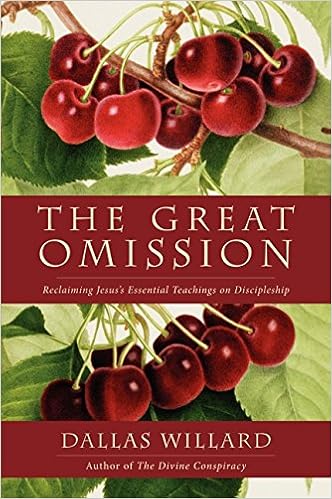
The Great Omission


The late Dallas Willard probably influenced more people in the art of discipleship and spiritual formation than any other writer in the last 50 years. Willard drew on the best of church history and Christian spirituality to help modern readers understand the essential teachings of Jesus. His books are a worthy investment even though at times they can be challenging to digest.

In The Great Omission, one finds a collection of articles, lectures, and other pieces clustered around the idea of discipleship. At times the book is repetitive given the nature of the compilation, but it is a great introduction to the thoughts of Willard. Willard contends that the great omission of the church is that we have focused on making converts (to a particular stream of Christianity) and baptized them into church membership without ever "enrolling people as Christ's students." The goal is formation of the inner character to be developed that operates out of the mind of Christ.

Wednesday, August 2, 2017

Befriend: A Book Review

Scott Sauls, a pastor in Nashville is quickly becoming one of my favorite spiritual voices on social media. I have read his books Jesus Outside the Lines and Befriend. In both books the reader senses Scott's heart for God and his passion for people to know God. He gently encourages the reader to join him in discovering what God is calling us to do as we follow Jesus.

Friendship is an interesting topic to tackle. We can have hundreds or even thousands of friends on Facebook and followers on Twitter or Instagram but do we really have genuine, meaningful friendships? Do we even know how to have those type of relationships anymore? Scott Sauls answers these questions and more as he offers encouragement for the believer to rediscover genuine, loving friendships with different types of people, different groups, and even oneself as modeled by Jesus. This is a great resource for a small group Bible study or accountability groups.


Thursday, January 12, 2017

My Top 5 Books of 2016

I love books. All kinds, old, new, short, long, fiction, and non-fiction. I confess that much of my reading derives from Christian spirituality and theology, so the list is bent in that direction. Some of these books I read for my doctoral classes, others I chose because of various factors. I read several meaningful books this year but these five books have been ones I have been drawn back to since reading them. Since five is a small number to list all of the great books, I added an honorable mention list. These aren't in any particular order either.

Tracks of a Fellow Struggler John Claypool
This brief book on grief is composed of four sermons Claypool preached as he wrestled with the diagnosis of Leukemia his daughter received. He recounts the emotions of diagnosis, treatment, remission, recurrence, and death. His honest doubting, searching, and questioning of God are the words of many people who have experienced the loss of someone dear to them. It is the best book on grief I have ever read!

Subversive Spirituality Eugene Peterson
Peterson always challenges the way I view myself, my calling, and my relationship with God. This book is a collection of shorter pieces: sermons, interviews, articles, poems. Some are better than others, but given the structure of the book the reader can skip around and read the ones most intriguing to him or her. His insight into pastoral ministry is especially helpful for anyone who is called to vocational ministry and missions.
Eugene Peterson

The Return of the Prodigal Son Henri Nouwen
Nouwen's insight into the parable is superb! His introspective writing invites the reader to place himself inside the mind of each character of the parable.

This Is Awkward Sammy Rhodes
I met Sammy when he was the RUF (Reformed University Fellowship) campus minister at Georgia Southern. He is now doing RUF work at USC (South Carolina). Reading this book is like having a conversation with Sammy at a coffee shop. Many people will connect with this book but especially those in the 30-40 age bracket. His witty take on faith and life leave you in stitches while realizing your own need of God's gracious work in your life.

The Death of Santini Pat Conroy
Southern novelists are some of the most keen observers of the human condition. They have a way of writing about the idiosyncrasies of the South while affirming the best parts of it. Conroy is a master storyteller. This book recounts his turbulent relationship with his father, USMC fighter pilot Don Conroy. At the end of Don's life and the end of the book there is redemption and reconciliation. Two powerful biblical themes that we need to be reminded of as often as possible.

Honorable Mentions:
Meditation Jim Downing
Daring to Speak for God Norfleete Day
Jesus Outside the Lines Scott Sauls
The Jesus Way Eugene Peterson
Grief Melissa Kelley
Turn My Mourning into Dancing Henri Nouwen
In the Heart of the World Mother Teresa
Sycamore Row John Grisham

Monday, February 22, 2016

A Lenten Book Review

As part of my personal observation of Lent, in preparation for Easter, I decided to read some selected books that focus specifically on issues associated with Lent. The books range on topics of sin, mourning, grace, frailty, and of course Jesus. I must admit that I haven't been able to read as quickly as I hoped to, but Lent isn't over, so I still have some time. My first selection, Turn My Mourning Into Dancing by Henri Nouwen, is a book I recently picked up at a discounted bookstore. I love finding cheap books! There is something about claiming a great book at a great price that lifts your spirit.

This book is really a collection of Nouwen's thoughts on grief and mourning that was compiled after his death. The book offers a reminder to the reader that even as we walk through mourning for ourselves, a loved one, a career, a relationship, or a phase of life, God's grace is present with us. God's grace is manifested in our moments of hurt, anguish, sorrow, and loss in ways that are never reproduced during the "good" times of life.

Nouwen says in the Introduction, "Suffering becomes a way into deeper fulfillment." Further into the book Nouwen offers these two thoughts that guide the rest of the book. "While Jesus brought great comfort and came with kind words and a healing touch, he did not come to take all our pains away. The way from Palm Sunday to Easter is the patient way, the suffering way."

The Psalmist writes, "You have turned my mourning into joyful dancing" (Psalm 30:11). Over the course of the last six years I have wrestled with losing people who are close and dear to me. Fathers, friends, relatives, each of them impacting my life in different ways. As I worked through my grief and loss especially with my fathers (my father and my wife's father) I realized that few people know how to grieve well with someone else. Most people, though well intentioned, offer some condolence and kind word, that stays with us long enough for spit to dry. I found even as a minister, not knowing how to console people until I experienced these loses and tried to make some sense of them in my own life. As I worked through my mourning, I found that joyful dancing did return, even if only in spurts at first. I also realized that what I most needed, and my hunch is that most people who mourn feel this way, was for someone to crawl inside the hole of sorrow with me and sit. I wanted, I needed the presence of friends who didn't try to fix my sadness, which was overwhelming. I needed someone to crawl in my hole and perhaps by their very presence remind me that God is present even in my mourning. "To live with compassion means to enter others' dark moments. It is to walk into places of pain, not to flinch or look away when another agonizes. It means to stay where people suffer." I found Nouwen's words to be true, "at the center of our grief we find the grace of God."

At the center of my experience with grief I found God's grace in deeper, richer tones than I ever had before. Nouwen's book is a excellent reminder of the overwhelming nature of sorrow and grief, which finds new meaning and purpose in light of the gospel.


Wednesday, May 14, 2014

Reflections on Discipleship

I am preparing to teach a course on Evangelism and Discipleship at Guido Bible Institute in Metter, so I have been trying to absorb some "new to me" books on those two topics to help enrich the class lectures. I came across a book by N.T. Wright entitled Following Jesus: Biblical Reflections on Discipleship and soaked it up in about a week. It is essentially a collection of sermons/lectures he has given around this theme. As with anything I have read by Wright I was challenged to expand my understanding of what it means to follow Jesus. I was also encouraged by what God is doing in and through me, as I am shaped on the anvil of Christ. Below are two comments that have really stuck with me.

Let's make no mistake about it; until you learn to live without fear you won't find it easy to follow Jesus. p. 67

The answer to temptation is to find out, perhaps painfully and over a long period, what it is about you that is at the moment out of shape, distorted, in pain. Then one may begin to find out, again often painfully, how it is that God longs to help you to get what is distorted back into focus; to get what is crooked back into shape; to get what is bruised and hurt back into health. p. 88 

Tuesday, May 13, 2014

Letters From A Skeptic

I finished reading Letters From A Skeptic recently and I was reminded of the power of honest questions and answers in helping a person discover Jesus. The book is a composite of letters between a father and son (Ed Boyd and Greg Boyd) as the father slowly makes a journey toward faith and belief in Jesus. His questions about Christianity are honest and straightforward for his son, who is a minister and theologian. Greg Boyd offers his dad, well thought-out answers, not patent Sunday school answers in an effort to be authentic. In the letters the reader sees the growth of the relationship between father and son in addition to the necessary spiritual growth of the senior Boyd.

This is a great resource for someone who is wrestling with questions about Christianity, the Bible, and Jesus. Because the letter format is preserved, the material comes across as genuine rather than academic, ethereal discussions about key doctrines and finer points of theology.

If you have a family member or friend who is struggling with certain aspects of Christianity this book is a great resource to give them. Read it with them and discuss the topics that the Boyd's cover.

Wednesday, September 11, 2013

Family Vocation

I recently finished Your Other Vocation by Elton Trueblood. The book though dated now in some ways (it was originally published in the 1950s) has some prophetic things to same about family life. Trueblood wrote about things that the church is now wrestling with in tremendous ways. Allow me to summarize some of his thoughts. He contends that a man may change jobs, business associates, and any number of occupational components but we cannot change our children. We can always get another job. We can always make adjustments to our career. In fact the new average is that Millenials will have 2-3 careers during their lifetime. "If we lose with our children our loss is terribly and frighteningly final" (82). We don't get second chances, usually to make it happen when it comes to parenting and nurturing our children. Yet how many parents work long hours and distance themselves from their children because of their career in an effort to "provide" for their children but the completely miss the opportunity to provide what they most want...and need.

Trueblood goes on to write about how our faith must impact our family life if it is real and genuine. "What occurs at the altar is insignificant unless what occurs there is supported by what occurs in the kitchen" (82).
A challenging chapter on family, that outshines the rest of the book.


Wednesday, July 31, 2013

Chesterton on Life and Faith

I have long wanted to read G. K. Chesterton's book Orthodoxy. This summer I finally marked it off my list. One can easily see his influence on another great thinker, C. S. Lewis. Here are few nuggets I found in my reading of the book.

"We have said we must be fond of this world, even in order to change it. We now add that we must be fond of another world (real or imaginary) in order to have something to change it to."

"Man is more himself, man is more manlike, when joy is the fundamental thing in him, and grief the superficial. Melancholy should be an innocent interlude, a tender and fugitive frame of mind; praise should be the permanent pulsation of the soul."

"Keeping to one woman is a small price for so much as seeing one woman. To complain that I could only be married once was like complaining that I had only been born once."

"Imagination does not breed insanity. Exactly what does breed insanity is reason."

"For orthodox theology has specially insisted that Christ was not a being apart from God and man, like an elf, nor yet a being half human and half not, like a centaur, but both things at once and both things thoroughly, very man and very God."

"Man will sometimes act slowly upon new ideas; but he will only act swiftly upon old ideas."

"But in that terrific tale of the Passion there is a distinct emotional suggestion that the author of all things (in some unthinkable way) went not only through agony, but through doubt. When the world shook and the sun was wiped out of heaven, it was not at the crucifixion, but at the cry from the cross: the cry which confessed that God was forsaken of God. They will find only one divinity who ever uttered their isolation; only one religion in which God seemed for an instant to be an atheist."


Sunday, December 30, 2012

Confusing Ministry and Calling

Margaret Feinberg recalls a conversation she had with a friend who had been dismissed from his ministry at a large church because of a moral lapse. The guy makes the statement that one's calling never changes, but our ministry can change every few minutes, at least several times in the course of our lives. She quotes him as saying, "The problem is that all too often we sacrifice our calling for the sake of the ministry. The ministry becomes so important, so central, that we lose the most important thing."

A great reminder for all those in vocational ministry. Our specific task of ministry may change repeatedly, for example in the last year I have transitioned from doing youth ministry to doing college ministry. Yet my calling has remained, seeing people's lives changed by the gospel. Of course most of us need to be reminded this important truth several times a week because we get so wrapped up in our ministry that we begin to place our self worth and value only in what we accomplish through ministry.

Excerpted from The Sacred Echo

Power of Words

Margaret Feinberg writes,
Why use sixty-six books and thousands of years of history to say three simple words? Because "I love you" is not just a piece of information or one-time revelation but an invitation to transformation.

Amazing to think of the trouble that God has gone through and still goes through to express his deep, unconditional love for us. He stopped at nothing, even sacrificing his only son because of his love affair with His people!

She goes on to say the following:
With mere words, God created. except for the moment when Jesus spoke, "It is finished," never has so much been accomplished in so few words.

I have always been mesmerized by the power of words, especially when contemplating the creation accounts in Genesis 1 and 2. The sheer power and authority evident in God's ability to speak something out of nothing, creation ex nihlio. This is the same God whom we bow down and worship as the loving Father who redeems us through his son, forsaken on a wooden cross. Two very simple acts with profound influence on the course of human history.


Monday, December 17, 2012

The Sacred Echo by Margaret Feinberg

I recently finished The Sacred Echo by Margaret Feinberg. She has quickly become one of my favorite contemporary writers. Her insight into issues of faith are refreshing without pushing the boundaries of orthodoxy. I will spend a few blog posts responding to some of her thoughts over the next few days. Here is one at the end that really resonated with me.

The naked truth about "getting saved" is that becoming a follower of Jesus will not make you richer, skinnier, or more prosperous. It will cost you everything--more than you can imagine--as you pour your life into causes that no one else seems to care about. But the rewards, well, I'm gambling with everything I've got that they're worth it. Like Lucy, it's worth believing and bringing everyone I possibly can along for the adventure (187).


Tuesday, August 7, 2012

Cast of Characters

Max Lucado is a master storyteller with a gift for helping his readers see the profound and indescribable aspects of God in ordinary, even mundane circumstances and language. In Cast of Characters, he traces the lives of key biblical characters and leaders and how God used them to accomplish his work in the world.

As with any Lucado book the reader finishes the book encouraged and renergized for their own faith journey.

Wednesday, June 6, 2012

The Gospel According to U2

I recently finished We Get to Carry Each Other: The Gospel According to U2. A great read for any rabid U2 fans or people who are intrigued by the intersection of pop culture, especially music and faith. Well written, although slightly biased by the author's own admission of fascination with the band, but would you really want to read a book about a band that was written by someone that didn't even like them? The mysterious ways the band has embraced and seemingly renounced Christianity through the years is intriguing to those in the church and outside of the church. The band is never one to be easily pigeon-holed into a particular category or framework though. They are all over the map on issues and faith, certainly not your typical representation of conservative, evangelical theology nor of "Christian music" though at times they model perfection in both worlds. Bottom line, if you like the band, you will enjoy this book!


Monday, March 26, 2012

The Demands of Jesus

In comparing the demands of the contemporary, evangelical church to the demands of Jesus, Mark Galli finds the church sufficiently lacking. It seems that in the church we want to make it as easy as possible to follow Jesus, yet that doesn't square with the picture of Jesus in the gospels.

So it seems we want some theological and moral demands made on us, but just not too many. Give us a somewhat challenging faith and we do just fine.  
Then along comes Jesus, telling us to cut off a hand or foot or cut out an eye if it gets in the way of serving him. He instructs us to abandon wives, sisters, brothers, and friends and put our lives on the line. I don't know about  you, but I'd much rather tithe, pray daily, serve on a couple of church committees, lead a men's Bible study, serve on the church board, and attend weekly worship. As exhausting as it is to be a good churchman, it's infinitely easier than the demands Jesus would make on my life.  
The point is simply this: if we've given ourselves to a contemporary, high-demand expression of faith, we should recognize that it doesn't even approach the demands Jesus makes on us. Even monastics, old and new, know that their sacrifices are ridiculously meager. And when this reality hits us from time to time--as well it should, if we're at all honest with ourselves--the only reasonable reaction is fear and trembling. What else would a sane person do after realizing that Jesus wants nothing less than all of us--every molecule, every breath, every ounce of energy, every interest, every passion, every thought, every action, every love? It certainly scares the bejeebers out of me (134-136). 


Sunday, March 25, 2012

Mark Galli's book Jesus Mean and Wild grabbed my attention because of the title, unfortunately the book was less engaging than I hoped. I was still able to distill a few great truths though.

Galilee is the beginning of things. Galilee is where Jesus was first revealed to us. Galilee is where we must go to get in touch with reality again.  
To go to Galilee means to remember what it was about Jesus that first connected with you. It means to explore those things that drew you into the faith in the first place. This Jesus likely left you with more questions than answers and perplexed you as much as fulfilled you. It took years to get all those answers and resolve those perplexities and thus year to refashion him in your image. Instead, return to the alluring, mysterious, captivating Jesus who first attracted you--not in a naive way (as if you've learned nothing), but in a way that sees the simplicity of Jesus within the complexity of faith (177). 

In writing about the encountering God in our world Galli writes,
God is found in the magnificence of Half Dome and in the miracle of the embryo, in the abandoned play of children, in intimate conversation over coffee. He is found when a husband and wife make love or when two or three are gathered in his name. He is found in the hungry, in the homeless, in the prisoners. And most specifically, he is found in his Word, in his body, and in the breaking of bread and the sharing of wine in his name (181-182).


Wednesday, September 28, 2011

The Prodigal God

I was first introduced to Tim Keller by my RUF (Reformed University Fellowship) campus minister, Paul Bankson while a student at Mercer University.  Paul often referenced some nugget of truth he had extracted from Keller's sermons he listened to on tape, yes I am that old...before podcasts and cd's of sermons there were tapes. In college I read one of Keller's books that talks specifically about service to the "least of these" but I hadn't read any of his recent books until I picked up Prodigal God at a bookstore going out of business. It was a great reminder of the depth of my sin and the lavishness of God's love and grace and mercy!

If the preaching of our ministers and the practice of our parishioners do not have the same effect on people that Jesus had, then we must not be declaring the same message that Jesus did (18-19).